
Decentralized Grocery Marketplace on ONDC
Enabling Local Retailers Through Open Commerce Infrastructure
Business Context
India’s Open Network for Digital Commerce (ONDC) was introduced to decentralize e-commerce by enabling local retailers to participate in digital marketplaces without relying on dominant platforms.
Unlike traditional grocery apps (e.g., BigBasket, Blinkit):
Pricing is not controlled by the platform
Inventory is managed by individual stores
Delivery may be store-managed or third-party
Platform has limited operational control
The opportunity:
Build a grocery marketplace that enables local stores to sell digitally while maintaining consumer trust in a decentralized ecosystem.
1.1 Business Objectives
Enable ONDC-integrated local grocery stores to sell via mobile app
Provide a consistent buying experience despite decentralized control
Support multi-store discovery and ordering
Handle store-led or third-party delivery options
Drive adoption among both retailers and consumers
This was not a traditional e-commerce build — it was a platform design problem under infrastructure constraints.
My Role
I led
Experience architecture for the consumer-side app
Marketplace trust design
Product discovery and listing structure
Multi-store cart logic
Delivery partner selection experience
Checkout and payment flow
Cross-functional alignment with ONDC integration teams
The Core Marketplace Challenge
Traditional grocery platforms control:
Pricing
Inventory
Promotions
Delivery SLAs
Refund policies
ONDC-based commerce removes that control.
This created three fundamental UX challenges:
Trust without centralized control
Clarity across multiple fulfillment models
Preventing platform blame for store-level issues
The design problem became:
How do we create reliability in an unreliable ecosystem?
3.1 Market & User Insights
Before structuring the marketplace experience, we analyzed grocery shopping behavior and existing platform expectations.
Key findings from survey and market analysis:
38% of users value time savings above all else
30% prioritize the ability to place large, consolidated deliveries
Security, contactless delivery, and cashless payment remain strong drivers
BigBasket and Blinkit dominate usage, setting expectations around speed and reliability
Unlike centralized grocery platforms, ONDC does not guarantee:
Standardized pricing
Delivery speed consistency
Inventory synchronization
Unified return/refund handling
This created a structural tension: Users expect platform-level reliability, but the infrastructure distributes responsibility across stores and delivery providers.
Therefore, the design strategy focused on:
Making fulfillment responsibility explicit
Reinforcing store identity throughout the journey
Surfacing delivery timelines early
Ensuring price and charge transparency at every step
This research reframed the problem from "building a grocery app" to designing a trust-first decentralized marketplace experience.
3.2 ONDC Channel App Landscape
Before defining our marketplace architecture, we analyzed existing ONDC buyer applications operating under the same infrastructure constraints, including:
Mystore
eSamudaay
SellerApp
ITCstore.in
These platforms faced identical structural realities:
Store-controlled pricing
Decentralized inventory
Variable delivery ownership
Limited centralized accountability
Observed Experience Patterns
Across these ONDC channel apps, we identified:
Inconsistent visibility of store identity
Limited clarity on who fulfills the order
Complex or layered navigation structures
Weak distinction between platform vs store responsibility
Insufficient price and charge transparency at checkout
Most apps prioritized network enablement but underinvested in consumer trust architecture.
Strategic Gap Identified
The ONDC ecosystem demonstrated infrastructure readiness — but lacked experience maturity.
Users entering these apps still carried expectations shaped by centralized commerce platforms. The gap was not feature-related; it was clarity-related.
Design Implication
We differentiated not by simplifying the system artificially, but by making its complexity legible.
This informed several structural decisions:
Persistent elevation of store identity
Explicit delivery partner selection
Store-grouped cart architecture
Transparent checkout breakdown
Reinforced fulfillment accountability
This analysis ensured our solution was ecosystem-aware rather than interface-deep.
Marketplace Architecture Decisions
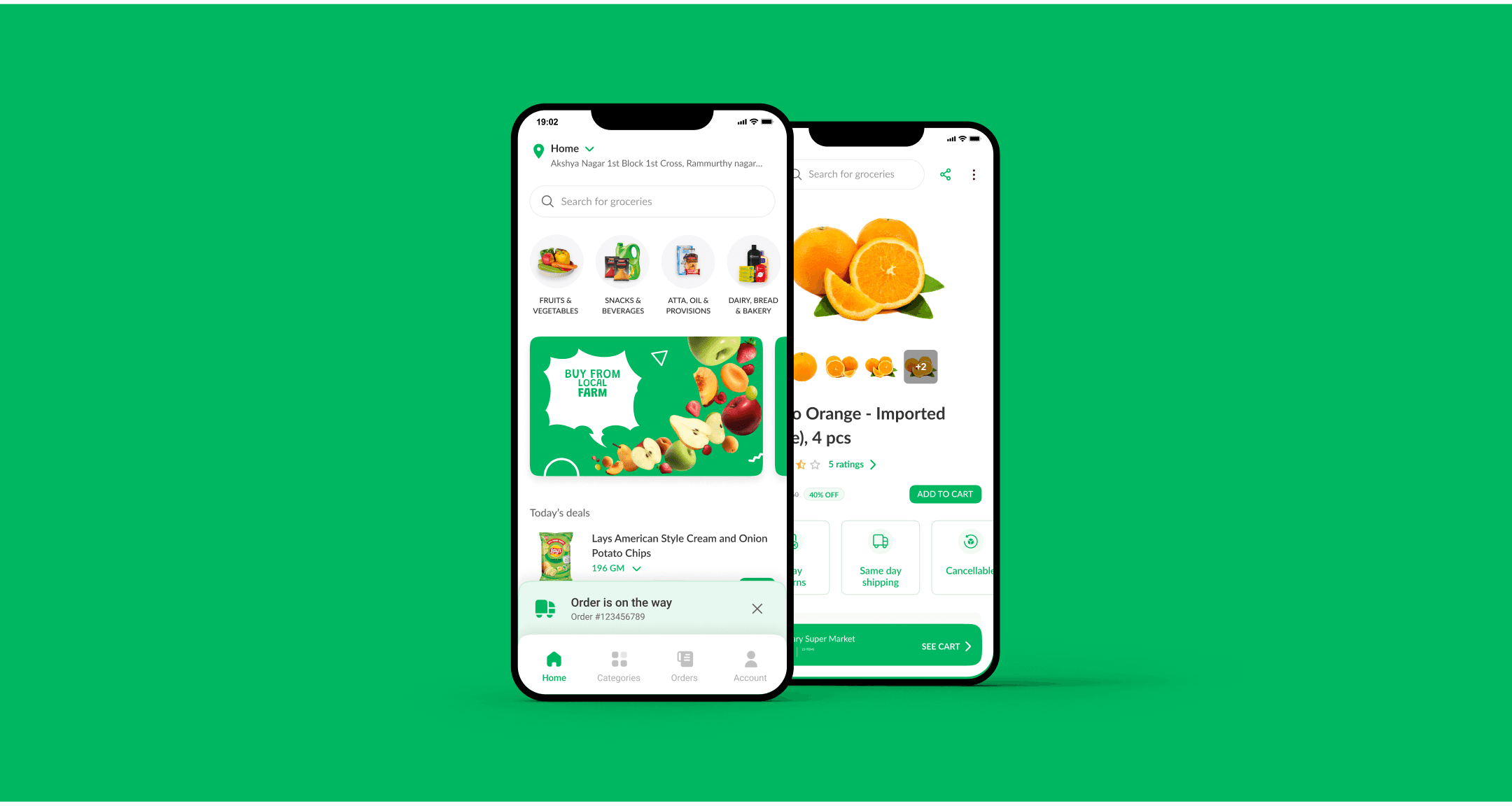
4.1 Store-Centric Transparency
Since prices were set by store owners, we made store identity explicit throughout the journey:
Store name visible in listing
Ratings displayed prominently
Delivery time clearly shown
“Free delivery” vs paid delivery explicitly separated
This reframed responsibility.
Users understood they were buying from a specific store — not from the platform itself.
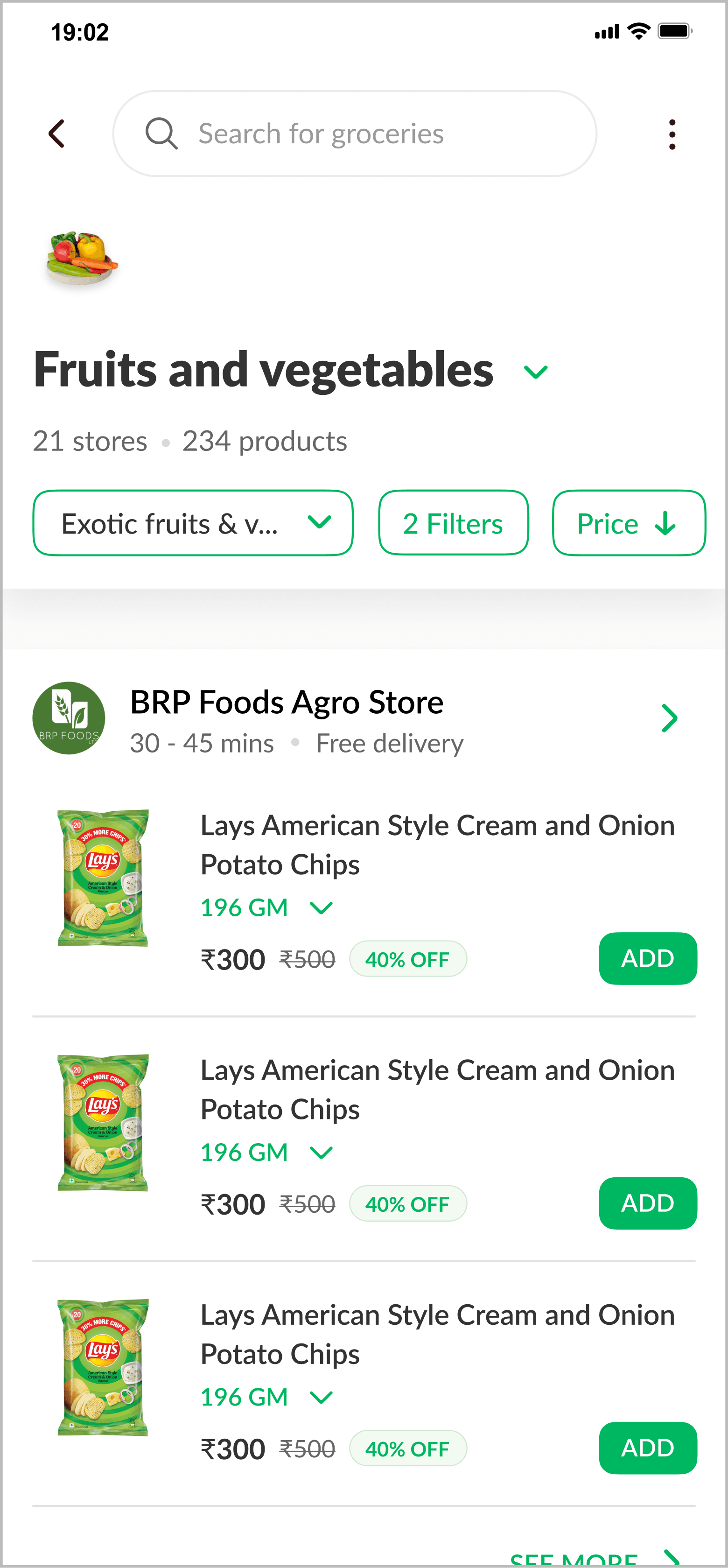
4.2 Multi-Store Product Discovery
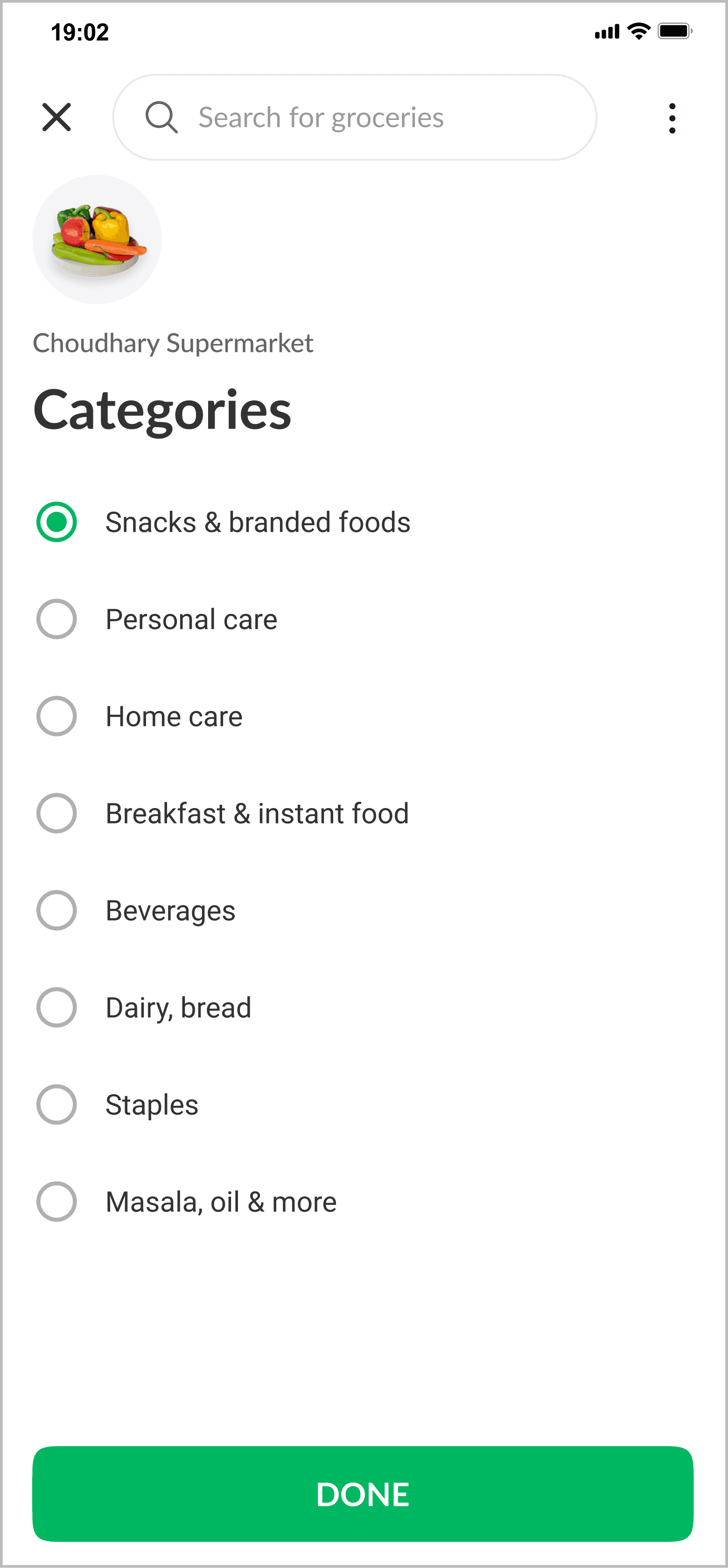
In category view:
Store metadata displayed with each product
Delivery time surfaced early
Filters accessible and contextual
Category selection layered by store context
This reduced confusion in decentralized listings.
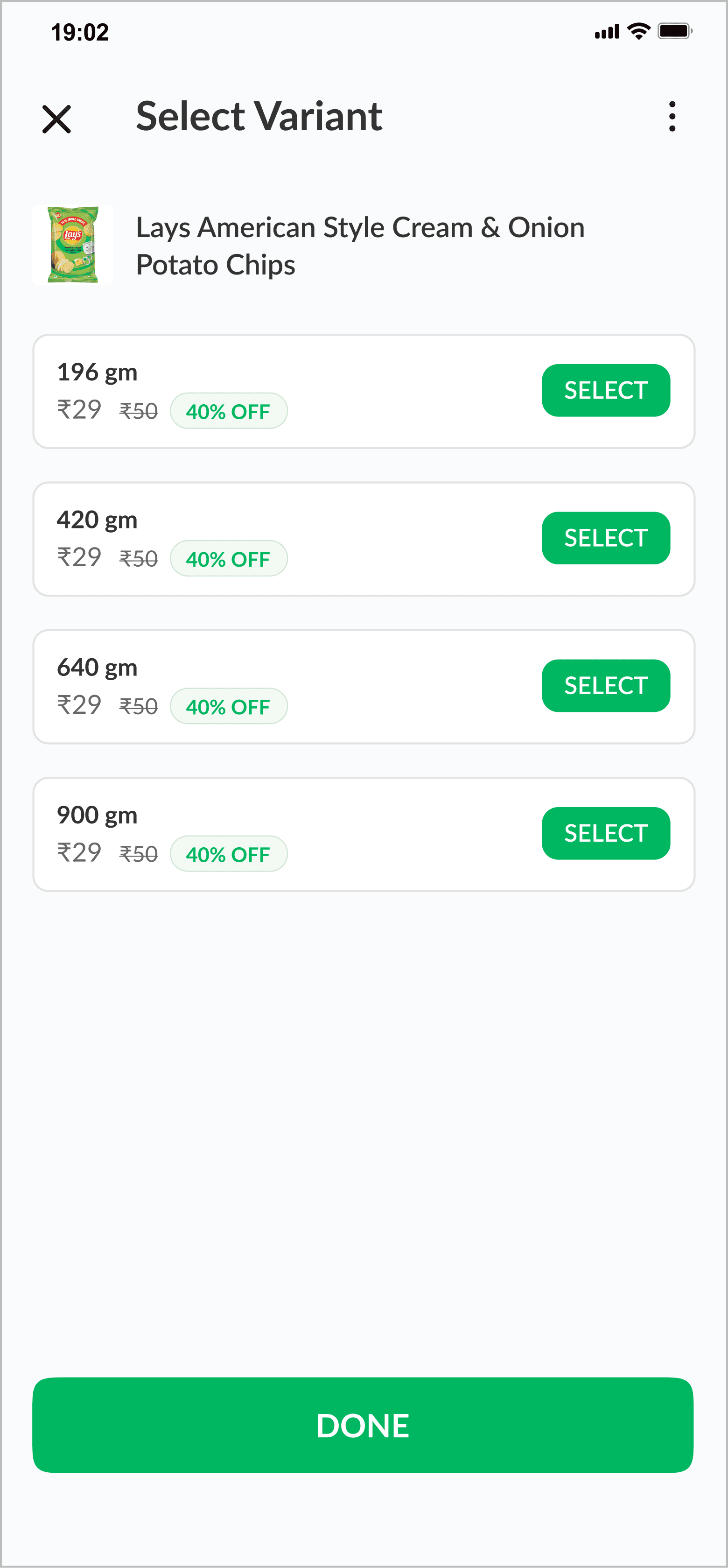
4.3 Variant & Inventory Handling
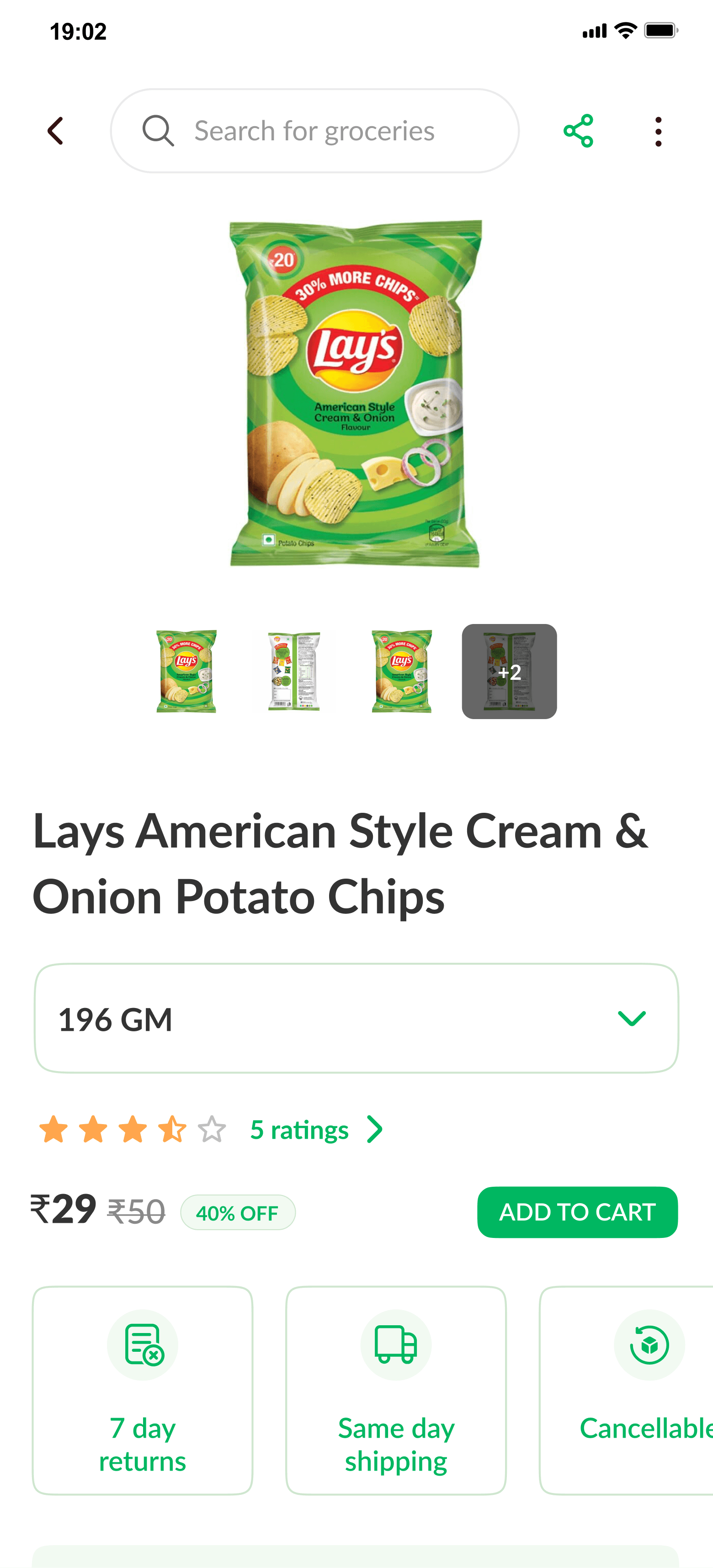
Variant selection (e.g., 196g, 420g, etc.) was designed as a separate step:
Explicit “Select Variant” modal
Clear price display per variant
Discount badge consistency
This reduced mismatch between store-managed inventory and consumer expectations.
Delivery Architecture
5.1 Dual Fulfillment Model
Users could choose:
Store-provided delivery (often free)
Third-party logistics providers (e.g., Dunzo, LoadShare)
We intentionally exposed delivery partner selection instead of auto-assigning.
Why?
ONDC does not guarantee fulfillment consistency
Store-led delivery may have different reliability
Pricing may vary
Transparency reduces friction
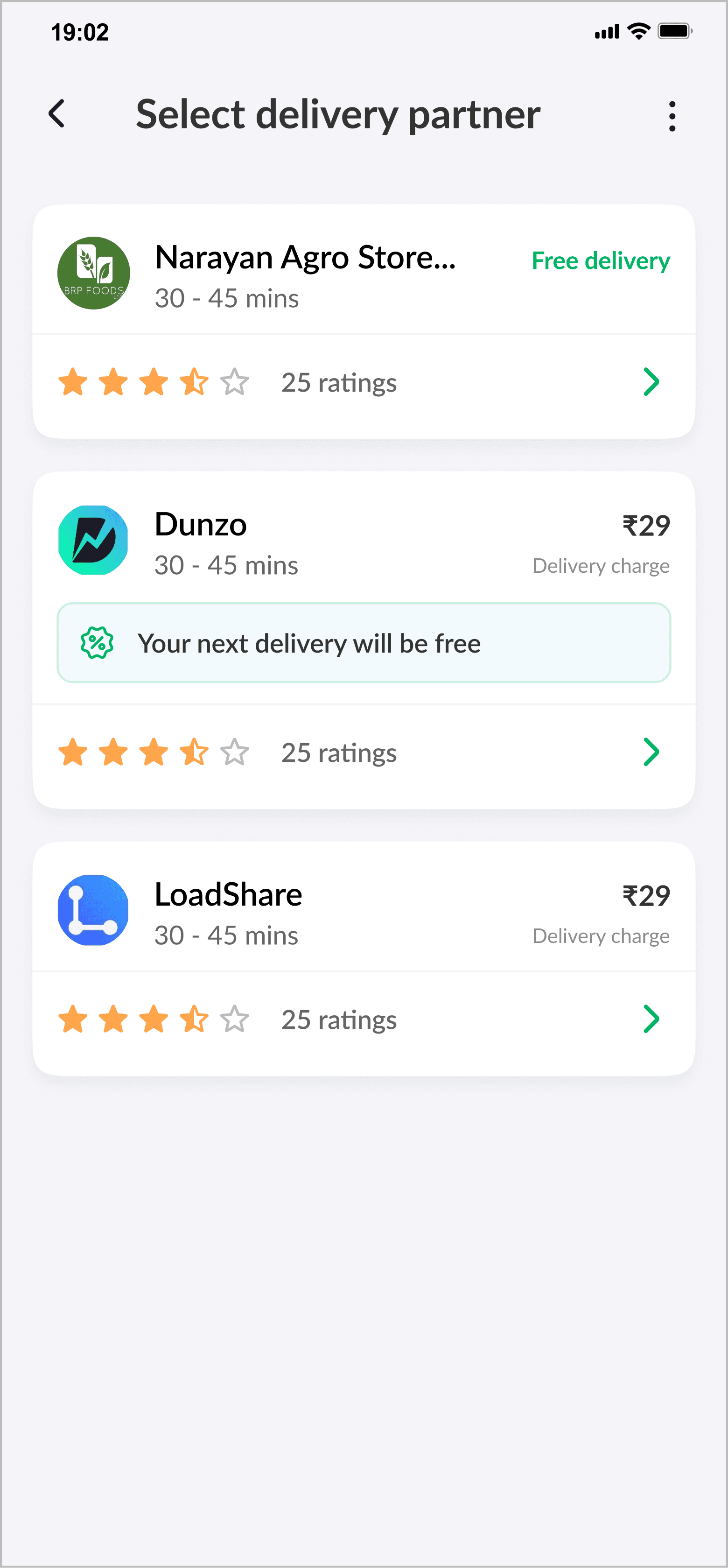
5.2 Delivery Partner Selection
Displayed:
Delivery time estimates
Ratings
Delivery charges
Promotional incentives
This shifted delivery from hidden backend logic to visible user choice.
It also reduced ambiguity in case of delivery failure.
Cart & Multi-Store Complexity
6.1 Store-Grouped Cart
Cart items were grouped by store:
Store header visible
Subtotal per store
Quantity controls per item
Clear separation of items
This supported:
Multi-store purchases
Store-specific delivery fees
Clear accountability
Without grouping, users might assume single-vendor responsibility.
6.2 Address & Delivery Context
Address confirmation was persistent and changeable within cart.
Delivery partner displayed again at checkout.
Redundancy was intentional — it reinforced clarity before payment.
Checkout Under Decentralized Control
Checkout had to handle:
Store pricing (variable)
Coupon application
Delivery charges (store or partner dependent)
Payment selection
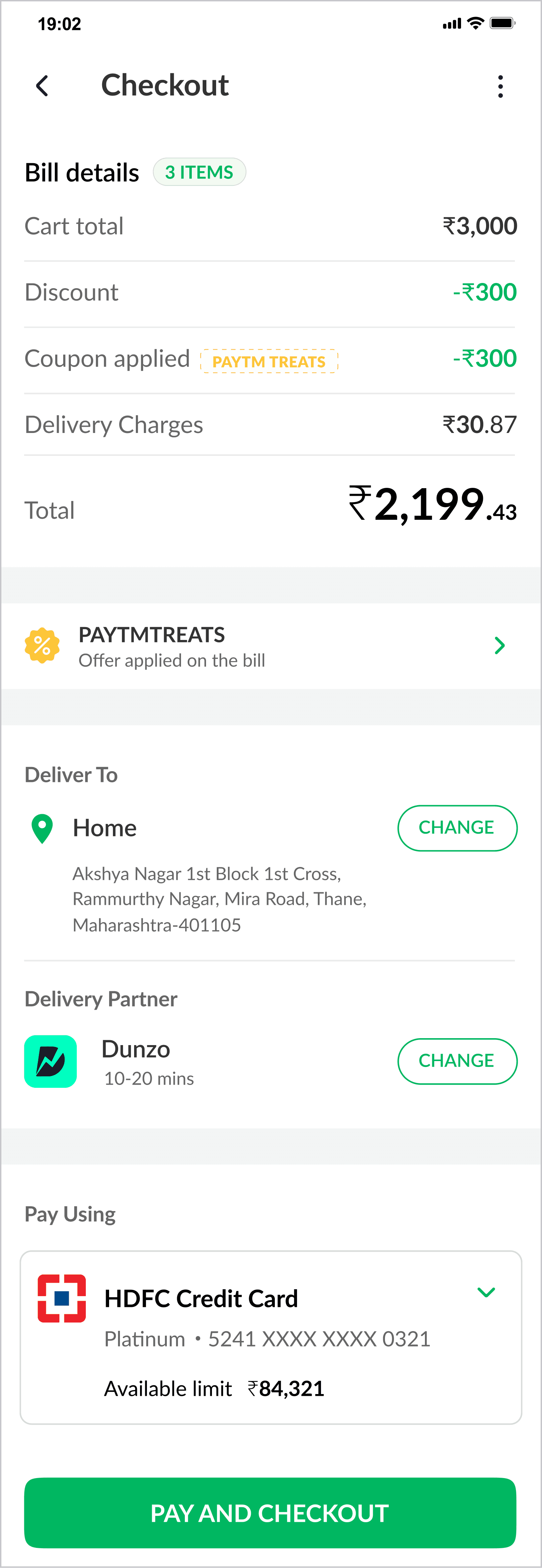
7.1 Bill Transparency
Breakdown included:
Cart total
Discounts
Coupon applied
Delivery charges
Final payable amount
Clear monetary breakdown was critical in decentralized pricing.
7.2 Payment Selection
Standard payment options were supported (e.g., credit card).
Given the complexity of upstream marketplace actors, payment clarity was emphasized.
Usability Validation & Structural Testing
8.1 Objective
Before finalizing the experience, we validated whether users correctly understood the decentralized marketplace structure. The goal was not visual refinement, but architectural comprehension.
We specifically tested whether users understood:
Multi-store cart grouping
Store-level responsibility
Delivery partner selection logic
Price breakdown transparency
Variant and inventory clarity
8.2 Method
Task-based usability testing using realistic grocery scenarios
Participants familiar with centralized grocery apps
Scenario included multi-store cart building and delivery comparison
Observed structural misunderstandings rather than UI preferences
8.3 Key Findings
Users initially assumed platform-level accountability.
→
Reinforced store identity at listing, cart, and checkout.
Users preferred to see the cheapest delivery option first, then the fastest.
→
Reordered delivery partner presentation accordingly.
Users compared prices across stores when searching for specific products.
→
Increased prominence of store metadata in listings.
Users built carts over multiple sessions before completing checkout.
→
Ensured cart persistence and clear subtotal grouping per store.
Hiding out-of-stock variants caused frustration.
→
Displayed unavailable variants visibly instead of removing them.
8.4 Architectural Impact
Validation led to deliberate structural refinements:
Increased repetition of store identity
Explicit delivery partner selection
Stronger price breakdown hierarchy
Clear accountability reinforcement across touchpoint
This reduced user confusion in a system where control was inherently distributed.
Post-Order Feedback
The “Order is on the way” persistent banner:
Reinforced order confirmation
Displayed order ID
Reduced post-purchase anxiety
In decentralized commerce, reassurance is essential.
Key UX Challenges & Trade-Offs
10.1 We Did Not Control Pricing
Solution:
Emphasized store identity
Displayed discounts explicitly
Surfaced price per variant clearly
10.2 We Did Not Control Delivery SLAs
Solution:
Made delivery partner selection explicit
Displayed delivery times and ratings
Allowed users to choose trade-offs
10.3 We Did Not Control Inventory Accuracy
Solution:
Explicit variant selection
Clear product-level metadata
Store-context reinforcement
Systems-Level Thinking
This project required designing for:
Consumers
Store owners
Delivery providers
Government-backed open network infrastructure
It was less about optimizing a funnel and more about designing:
Governance clarity
Trust signals
Accountability architecture
Expectation management
Impact
Successful ONDC integration
Multi-store order support
Operationalized store-led + third-party delivery model
Reduced confusion in decentralized purchasing
Most importantly:
It translated an open commerce protocol into a coherent consumer experience.
Key Takeaway
Designing in a decentralized ecosystem shifts the role of UX from interface optimization to trust architecture.
When control is distributed, clarity becomes the product.